
Earlier this month, I attended the National Institute on the Teaching of Psychology (NITOP) in what I hope will be their new conference home at the Grand Hotel Golf Resort & Spa in Point Clear, Alabama. It’s a relaxing location with excellent food and friendly staff.
The three keynotes at NITOP 2026 (Lisa Diamond, Claude Steele, and Markus Brauer) gave me a lot to think about, as NITOP keynotes usually do.
Lisa Diamond is Distinguished Professor of Psychology and Gender Studies at the University of Utah. Her talk was titled “Your textbook is out of date: What we know now about gender and sexuality, and how to teach it.”
For her classes, she encourages her students to think about the research on gender and sexuality as a researcher does. How do we operationally define these concepts? How do we measure them?
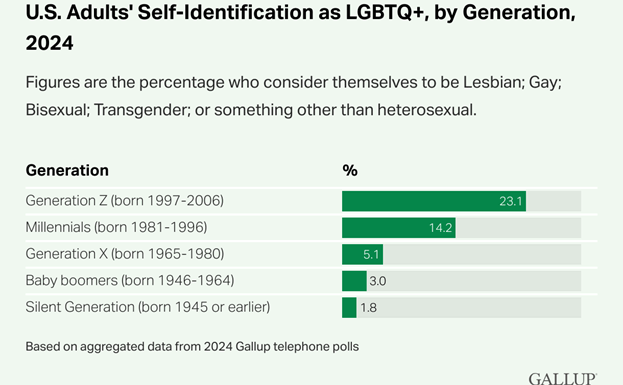
Diamond shared some fascinating Gallup data (Jones, 2025).
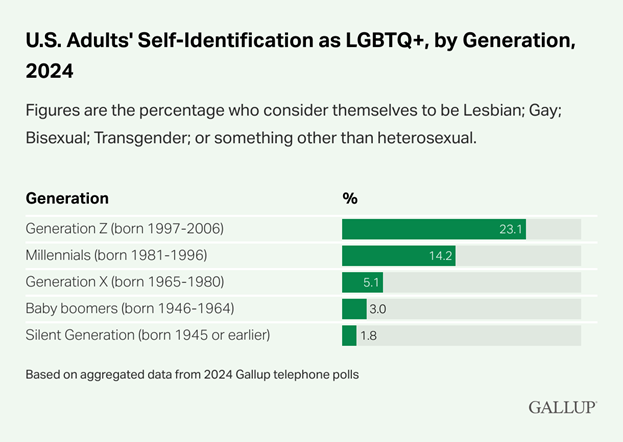
[Graph is posted with permission per the requirements of Gallup’s use policy.]
A whopping 23% of Gen Z participants—almost a quarter of your traditional-age students—in this 14,000-person survey of U.S. adults said they identified as “lesbian, gay, bisexual, transgender, or something else” (Jones, 2025).
One reason for higher LGBTQ+ identification among younger generations of adults is that they are much more likely to consider themselves bisexual than are older people. In fact, more than half of Gen Z (59%) and millennial (52%) LGBTQ+ people are bisexual. That drops to 44% among LGBTQ+ people in Generation X, and is less than 20% among baby boomers (19%) and Silent Generation (11%) LGBTQ+ adults. Older LGBTQ+ people are most likely to identify as gay or lesbian (Jones, 2025).
I wonder if survey participants are selecting “bisexual,” because, of the options given, it is the closest to their experience even though it doesn’t quite capture it.
Let’s consider a term that the Gallup survey did not use: heteroflexible. If you’re not familiar, this article written by a sociology professor a quarter century ago will explain it to you in a lighthearted way (Essig, 2000). That highly esteemed resource for all things cultural, the Urban Dictionary, defines heteroflexible as “An inbetween [sic] between bisexual and straight. A person who is mainly straight but does sometimes find the same gender appealing” (Bieber, 2015).
If we travel back in time 50 years, the survey options may have been simply homosexual or heterosexual. Or maybe even gay/lesbian or straight. I remember having classroom discussions in the 90s about identity, behavior, and attraction. Those three do not always align. For example, let’s take a man who regularly dates women but once or twice a month has sex with men. Decades ago, when presented with the survey options of gay or straight, he likely would have chosen straight. Years later, researchers added bisexual as option. Given the option of gay, straight, or bisexual, our guy would probably still have chosen straight since most of his sexuality was expressed with women. He doesn’t want a long-term relationship with a man, just sex every so often.
Meanwhile, beginning some time in the late 90s, social norms began to shift. Same-sex sexual experiences became more acceptable. I remember meeting the occasional woman who said she had been a “college lesbian.” Such women identified themselves as heterosexual. They had same-sex sexual experiences in college, but not since. In 2008, Katy Perry’s I Kissed a Girl topped the pop music charts. You know a behavior has gone mainstream when it’s the topic of a pop music hit. Of course, we should acknowledge that same-sex behavior between women has always been a bit more acceptable than same-sex behavior between men. To my knowledge, no major male music pop star has performed a song that could be titled I Kissed a Guy.
Let’s return to the Gallup survey. People in the earlier generations settled long ago into their identities. Yes, identities can change, but it’s harder to change one’s identity than it is to establish an identity in the first place. Let’s take our guy who dates women but occasionally has sex with men. If he is a member of the Silent Generation (born in 1945 or earlier), a Baby Boomer (1946-1964), or a member of Generation X (1965-1980), he is most likely to identify as straight. If he is a Millennial (1981-1996)—who would have been between 12 and 27 when Katy Perry’s song was released—or a member of Generation Z (1997-2006), “straight” may feel disingenuous. With generational social norms being more accepting of same-sex sexual behavior, it’s likely easier to say that one is not straight. But if not straight, what?
Let’s go back to this Gallup statement: “In fact, more than half of Gen Z (59%) and millennial (52%) LGBTQ+ people are bisexual” (Jones, 2025). [Quick comment. My researcher brain would have preferred this sentence to say… ‘people identify as bisexual’ rather than ‘people are bisexual.’ We don’t know how people really ‘are.’ We only know how they identify.] Anyway, I wish I had access to the questions Gallup actually asked because I want to know the wording of the follow-up question that generated the bisexual data. If “straight” doesn’t fit, then what is the best option of the remaining choices? “Bisexual,” it seems.
I wonder how many of those Gen Z’ers and Millennials would have chosen “heteroflexible” if it had been an option.
The lesson for students: Researchers are influenced by time and place, as we all are. The questions researchers ask influence the answers they receive.
References
Bieber, C. (2015, November 10). Urban Dictionary: Heteroflexible. Urban Dictionary. https://www.urbandictionary.com/define.php?term=heteroflexible
Essig, L. (2000, November 16). Heteroflexibility. Salon. https://www.salon.com/2000/11/15/heteroflexibility
Jones, J. M. (2025, February 20). LGBTQ+ identification in U.S. rises to 9.3%. Gallup. https://news.gallup.com/poll/656708/lgbtq-identification-rises.aspx
