
The Art of Teaching
I recently started revising my social psychology textbook. I was knee-deep in Chapter 3: Social Affect when I received a text from my friend and fellow textbook author Susan Nolan. She sent me this xkcd cartoon. Take a minute to go read it. I’ll wait.
Whether you call it the curse of knowledge, the expert blind spot, or even the hindsight bias, everyone who teaches—and that includes those of us who teach through our writing—has to set aside what we know, imagine what it is like to be a novice, and then help our students get from where they are to where we are.
I recently saw on that upstanding bastion of quality news, cheezeburger.com, a summary of a discussion where a hotel front desk agent was complaining about clueless hotel guests. A fellow agent chimed in that while most of the people who check into hotels are seasoned travelers, not everyone is. For those novices, this is a completely new experience; they don’t know the rules or the expectations. Or if it’s been a while since they’ve checked into a hotel, the rules may have changed. For desk agents, the commenter noted, “It’s Tuesday”(Cetra, 2026).
In some customer service situations, including healthcare, I’ve had the person I’m interacting with speak so quickly that I had to ask them to repeat what they said but more slowly. I know they say this same thing 50 times a day. I, however, am hearing it for the first time.
We’re all familiar with the science of teaching. Journals like the Teaching of Psychology and the Scholarship of Teaching and Learning in Psychology are chock-full of articles on the science of pedagogy. However, being able to time travel backwards to when we were not experts is an art. I’m going to go so far as to call it literally an art.
There are people who can render on paper a reasonably accurate representation of the world. I am not one of them. If asked to draw a door, I will draw a rectangle, because I know that doors are rectangular. Representational artists would also draw a rectangle if the point of view is looking directly at a closed door. If, however, the point of view is from an angle or if the door is open, what they’ll draw is a trapezoid.
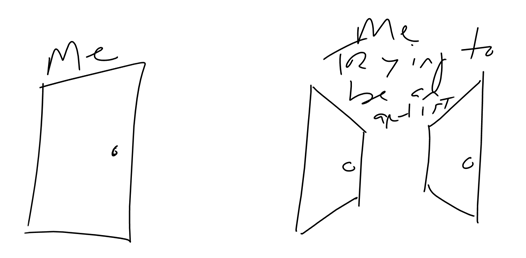
I understand the concept of shape constancy. When our eyes see an opened door, the light waves hitting our retina pick up the trapezoid. Our brain takes that trapezoid and processes it as a door. Our brain knows that what we are seeing is a rectangular door, not a trapezoidal block of pressed wood.
What is amazing to me is that representational artists can erase their perception—ignore their brain’s interpretation—and reproduce on paper what their eye sees—the trapezoid.
What is amazing to those who are not teachers is that artists of teaching are able to erase our knowledge—ignore what our brain knows—and go back to a time when we were novices—and see the world through our students’ eyes.
Yes, we can zip through our coverage of classical conditioning in no time. If our students fully understand classical conditioning, they have no trouble following us. Although, if they fully understand classical conditioning, why are we using valuable class time to cover it? To us, classical conditioning is practically obvious. To our students who are being introduced to the concept for the first time—or worse, to our students who believe they understand it (no, a cat running to the kitchen at the sound of a can opener is not an example of classical conditioning), classical conditioning is not obvious. As teachers, we have to set aside what we know and see the concept as our students see it. That is the art of teaching.
Reference
Cetra, M. (2026, October 19). “I’m just so tired of guests acting like we’re personally inconveniencing them for simply doing our job”: Front desk employee is tired of hotel guests having no etiquette or manners. https://cheezburger.com/47148293/im-just-so-tired-of-guests-acting-like-were-personally-inconveniencing-them-for-simply-doing-our-job
