Coca leaves and ayahuasca in Peru
My wife and I recently took a 2-week bucket-list trip to Peru. Yes, Machu Picchu was amazing.
Getting to Machu Picchu is not easy. First, you fly from the coastal city of Lima to Cusco (altitude: 11,000 ft), then take a 2-hour bus ride to Ollantaytambo (altitude: 9,100 ft), and then take a 90-minute train to Aguas Calientes (aka Machu Picchu Pueblo; altitude: 4,500 ft). From this village, you board a public bus that takes you up the 30-minute switchback to Machu Picchu (altitude: 7,972 ft).
Chewing coca leaves or drinking coca leaf tea produces a mild stimulant effect that local lore suggests helps with altitude sickness, the most common symptom of which is headaches (Cleveland Clinic, 2023). What does the research say? Very little, actually. Such a small amount of quality research has been done, it is hard to say if there is an effect, and if there is, it may not be more than a placebo (Bauer, 2019).
If you’d like, this would be a good place to give your students some experimental design practice. Hypothesis: Chewing coca leaves alleviates (or prevents) the symptoms of altitude sickness. What would be a good control condition to pair with the coca leaves? They will need an operational definition of “chewing coca leaves,” e.g., number of leaves, chewed for how long. Which symptoms of altitude sickness would they measure and how? Would their volunteers chew the leaves after experiencing symptoms or before?
Because the residents of the Andes are already acclimated to the altitude, they are not using coca leaves for altitude sickness. They may use them for their mild stimulant effect, much like people use coffee or energy drinks.
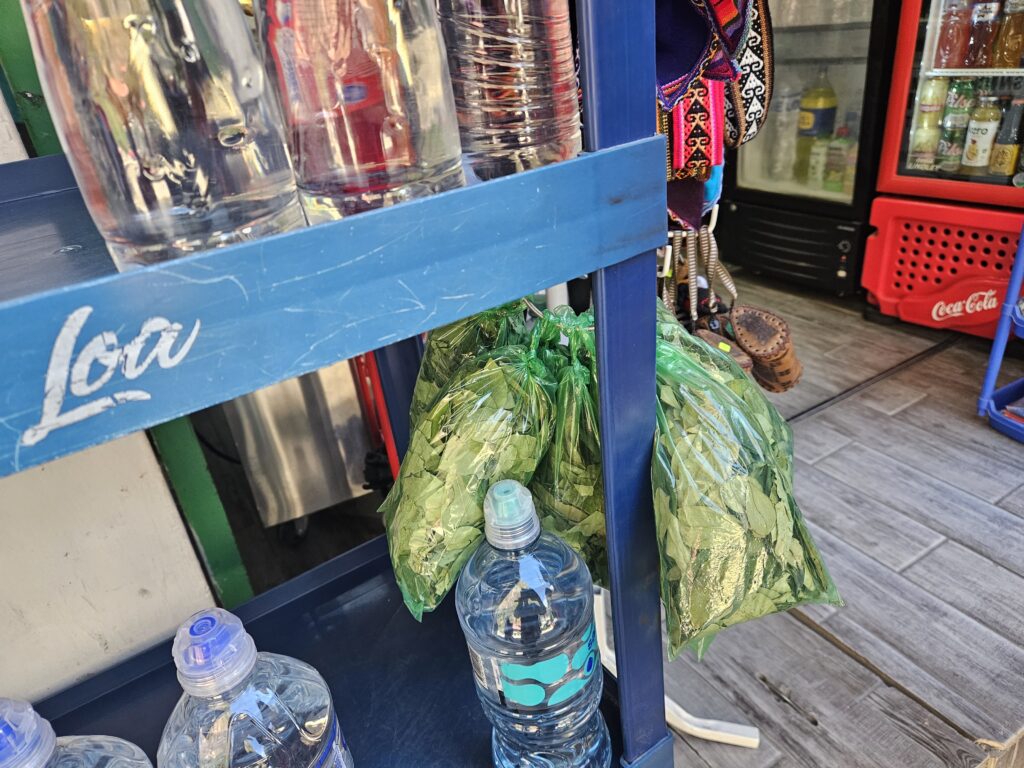
Coca leaves were present everywhere in the Andes. I saw bags of them for sale in Aguas Calientes.
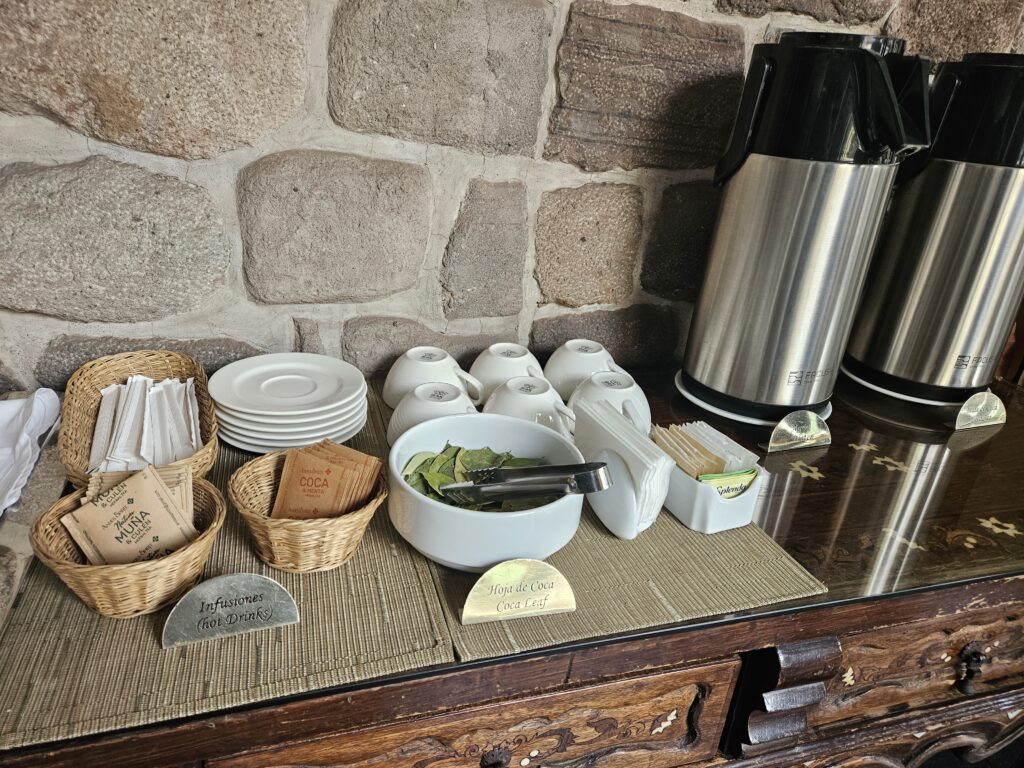
Our hotel in Cusco had coca leaves freely available with the tea supplies. You could choose between a coca and mint tea bag or the loose-leaf coca.
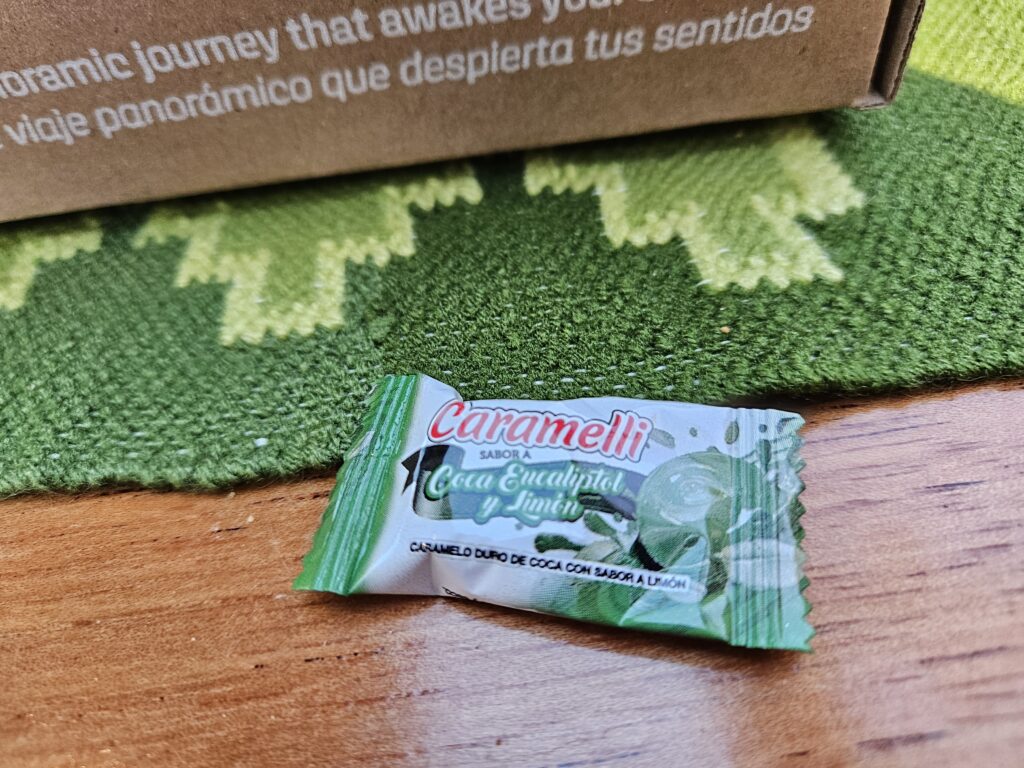
On the train ride to Agua Calientes, the free snack box contained coca leaf candies (and some excellent quinoa-based bars and cookies).
I can’t even say from anecdotal personal experience that coca leaves helped my altitude sickness because I didn’t have altitude sickness. We live at 4,300 ft, so we were already acclimatized to some altitude. If I were going to feel the altitude, it would have been in 11,000-ft Cusco. But our hotel pumped extra oxygen into our room, so it was like sleeping at a much lower altitude.
I considered chewing coca leaves or drinking the tea just for the experience, but our guide said that a common side effect was insomnia, which makes sense for a mild stimulant. Sleeping well when traveling was hard enough; I didn’t need to compound the problem. Our guide cautioned that using coca leaves would result in a positive drug test for cocaine. The research backs up his statement (Rubio et al., 2019). I couldn’t imagine the circumstance where I would be taking a drug test, but I decided there was no need to risk it.
Our guide also noted that while it was not illegal to take coca leaves out of Peru, it was illegal to bring them into other countries, such as the United States. We didn’t bring any back with us, but I wondered if luggage on flights from Lima were subject to extra scrutiny.
On this trip, we also visited the Peruvian Amazon rain forest. The closest city is Iquitos, and there are only two ways to get there. You can either take a boat (a few days) or a plane (two hours or so). We took a plane. From Iquitos, we traveled an hour by boat down the Amazon River to our lodge.
A traditional healer kindly took the time to share information with us about several plants he uses. One was the vine ayahuasca (see photo below). The stems of the vine are brewed into a tea that produces hallucinations. Ayahuasca is used as part of a multi-day, supervised, spiritual experience that is repeated every few days over several months.
Visitors to Peru seeking a hallucinogenic experience may spend US$200 to $300 for a single dose of ayahuasca. Not my kind of tourism.
References
Bauer, I. (2019). Travel medicine, coca and cocaine: Demystifying and rehabilitating Erythroxylum – a comprehensive review. Tropical Diseases, Travel Medicine and Vaccines, 5(1), 20. https://doi.org/10.1186/s40794-019-0095-7
Cleveland Clinic. (2023, August 21). Altitude sickness: Not always an uphill battle. https://my.clevelandclinic.org/health/diseases/15111-altitude-sickness
Rubio, N. C., Moreda-Piñeiro, A., Álvarez-Freire, I., Bermejo-Barrera, P., Tabernero-Duque, M. J., & Bermejo, A. M. (2019). The probability to detect cocaine, methylecgonine, cinnamoylcocaine, hygrine and cuscohygrine in urine samples of coca leaves chewers after six years. Microchemical Journal, 151, 104215. https://doi.org/10.1016/j.microc.2019.104215